




What Is LED Display Refresh Rate?
Refresh rate measures how many times per second an LED display redraws its image, expressed in Hertz (Hz). A 60Hz screen redraws its image 60 times per second, while a 3840Hz screen redraws 1,920 times per second. Do not confuse refresh rate with frame rate: frame rate is how many frames your video source sends each second, while refresh rate is how often the LED panel itself updates.
To the human eye, anything above 60Hz already looks smooth and flicker-free. But to a camera, the story is very different — and this is where many LED buyers make a costly mistake.
Why Refresh Rate Matters for Cameras
When you film an LED screen, the camera shutter captures the screen in short, rapid bursts. If the screen refreshes slower than the camera captures, the camera will record the moments between refreshes, when the display is momentarily dim. This produces three visible problems in the footage:
- Flicker — the screen appears to blink or pulse in the video
- Scan lines — dark horizontal bands that roll slowly across the image
- Color shift — colors look washed out, uneven, or distorted
These artifacts are invisible to the naked eye but completely ruin professional video, broadcast, live-stream, and event recording. A screen that looks perfect in person can look broken on camera if its refresh rate is too low.
Why 3840Hz+ Is the Sweet Spot
A refresh rate of 3840Hz or higher solves these camera problems almost entirely. At 3840Hz, the screen redraws so fast that a camera shutter can rarely catch a "gap" between refreshes, even at high shutter speeds. This is why 3840Hz has become the mainstream standard for professional applications.
- 3840Hz — the baseline for broadcast studios, stages, and live events
- 3840Hz — preferred for slow-motion and high-speed camera work
- 960Hz — acceptable only for low-cost fixed indoor screens that are never filmed
As a simple rule: if the screen will ever appear on camera, choose 3840Hz or higher.
How to Choose the Right Refresh Rate
Match your refresh rate to how the screen will be used:
- Indoor fixed screens not filmed: 3840Hz for quality and future-proofing
- Broadcast studios, TV stages, newsrooms: 3840Hz minimum
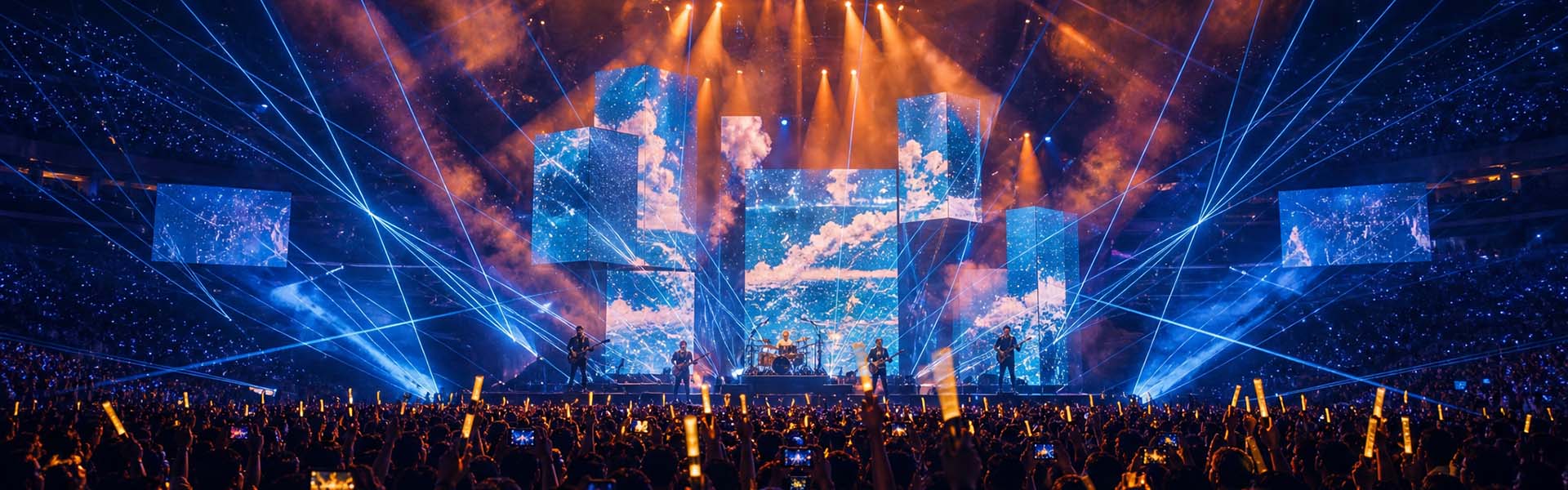
- Live events and concerts with slow-motion cameras: 3840Hz recommended
- Rental screens: high refresh rate increases booking value and client trust
Also check that the driver IC supports high gray scale (14-bit or more) and PWM dimming, because refresh rate works together with gray scale to produce clean, camera-friendly pictures.
HD COLOR‘s Solution
At HD COLOR, our indoor and outdoor LED displays use premium driver ICs that support 3840Hz to 3840Hz refresh rates, high gray scale, and flicker-free PWM dimming. We help overseas buyers select the right refresh rate for each project, so your screens look flawless both in person and on camera. Contact our team for a tailored recommendation and a free quotation.
 HD COLOR
 86-15889379986
 HD color
